Zampanò
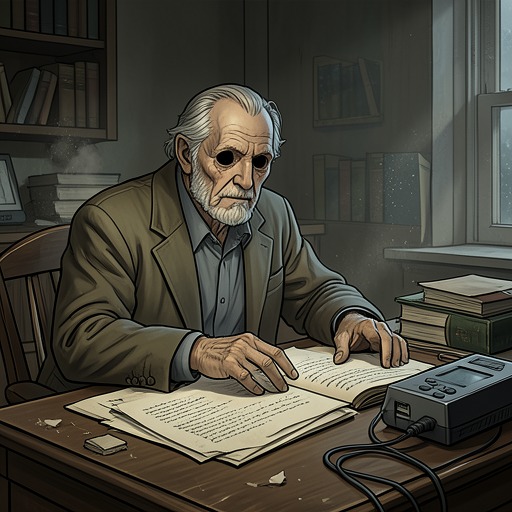
House of LeavesZampanò is the reclusive old man whose death releases the vast, unstable manuscript at the center of House of Leaves. Blind since the mid-1950s yet relentlessly writing about sight, darkness, film, and documentary evidence, he embodies the book’s governing paradox: a work devoted to seeing is produced by someone who cannot see, and a supposedly authoritative text survives only through the uncertain labor of others.
Identity and Elusive Background
Zampanò’s identity is never securely established. The name is the one he entered on his apartment lease and on several other surviving fragments, but no passport, license, or other official document was found to confirm that he was an actual, legally documented person. His American nationality is only an inference, and people who worked with him noticed an accent without being able to locate its origin. The name itself therefore remains unstable: it may be authentic, invented, borrowed, a nom de plume, or a nom de guerre.
According to Lude, Zampanò had lived in the building for many years while keeping mostly to himself. He nevertheless followed a strict daily ritual, appearing every morning and evening to walk through the courtyard, which was then overgrown with knee-high weeds and inhabited by more than eighty stray cats. The cats repeatedly rubbed against his legs even though he offered them no apparent inducement, giving the solitary figure one of his few visible forms of companionship.
Blindness and the Practice of Seeing
Zampanò’s intellectual project is organized around visual perception. His writing returns repeatedly to what people see, the conditions under which they see it, and what remains invisible. Light, space, shape, line, color, focus, tone, contrast, movement, rhythm, perspective, and composition recur as subjects because the manuscript concerns The Navidson Record, a documentary film made by the photojournalist Will Navidson that attempts to capture darkness itself.
The apartment turns this subject into a physical contradiction. At first it appears eclectic but not especially grotesque; closer attention reveals unused candles, an absence of clocks, strangely pale books, and scarcely any bulbs, even inside the refrigerator. The visual language of Zampanò’s work is thus surrounded by objects that have ceased to perform their ordinary functions. The irony is decisive: he writes about light, film, and photography despite having seen nothing since the mid-1950s. Zampanò is blind, and almost half of his books are in Braille.
His blindness is not presented merely as a biographical limitation. It changes the conditions under which his work can exist. The subject of visual evidence reaches him through language, memory, tactile reading, dictation, and the reports of others. The apparent authority of his analysis is therefore inseparable from a structural absence: the writer who most insistently interprets seeing cannot verify visual experience directly.
Readers, Dictation, and Unfinished Work
Lude and Flaze reported that Zampanò received numerous readers over the years. Some came through community centers or the Braille Institute; others volunteered from USC, UCLA, or Santa Monica College. No one consulted for the account claimed to know him well, but the arrangement suggests that his authorship was never solitary in a practical sense. Female readers were especially central to his working life. Zampanò openly described the soothing tones of women’s words as the greatest comfort in his life, apart from his own words.
Zampanò was, in the account’s formulation, a graphomaniac. He wrote until the day he died, repeatedly approaching completion without finishing anything, including the work he confidently called his masterpiece or his precious darling. Even on the day before his final disappearance from the courtyard, he was dictating long passages, revising earlier pages, and restructuring an entire chapter. His mind continued branching into new territories instead of settling into closure.
The manuscript that remains reflects this condition materially. It consists of reams of fragments found on old napkins, the torn edges of an envelope, and even the back of a postage stamp. The pieces are handwritten or typed, legible or illegible, lucid or impenetrable; they are torn, stained, taped, faded, burned, folded and refolded until creases erase passages. Layers of amendments and cancellations make it impossible to separate a stable original from its revisions. The surviving text may seem to designate truth, deceit, prophecy, lunacy, or nothing determinate at all, and its physical disorder becomes part of its meaning rather than a mere obstacle to reading.
Death and Posthumous Authority
Zampanò’s death is the event that makes his unfinished writing available to the world of the book. The old man dies without resolving the work that occupied him, leaving behind not a completed masterpiece but a proliferating archive whose gaps, contradictions, and damaged surfaces require reconstruction. His death supplies finality to his body while denying finality to his text.
The woman who saw him last concluded that something he could never quite address in himself prevented him from settling, and that death finally accomplished what writing could not. This assessment offers a possible psychological explanation, but it does not settle the matter. Zampanò’s motives remain filtered through recollection, hearsay, and fragments, while the manuscript itself continually defeats the expectation that an author’s intention can stabilize meaning.
For that reason, Zampanò functions less as a fully recoverable biographical person than as an absent center around which readers, editors, witnesses, and textual debris circulate. His name may be genuine or fabricated; his work may be profound, absurd, or both; and its significance cannot be guaranteed by his stated intention. The book turns his unfinished labor into an open structure, compelling later readers to decide what, if anything, the accumulated pages finally tell them.